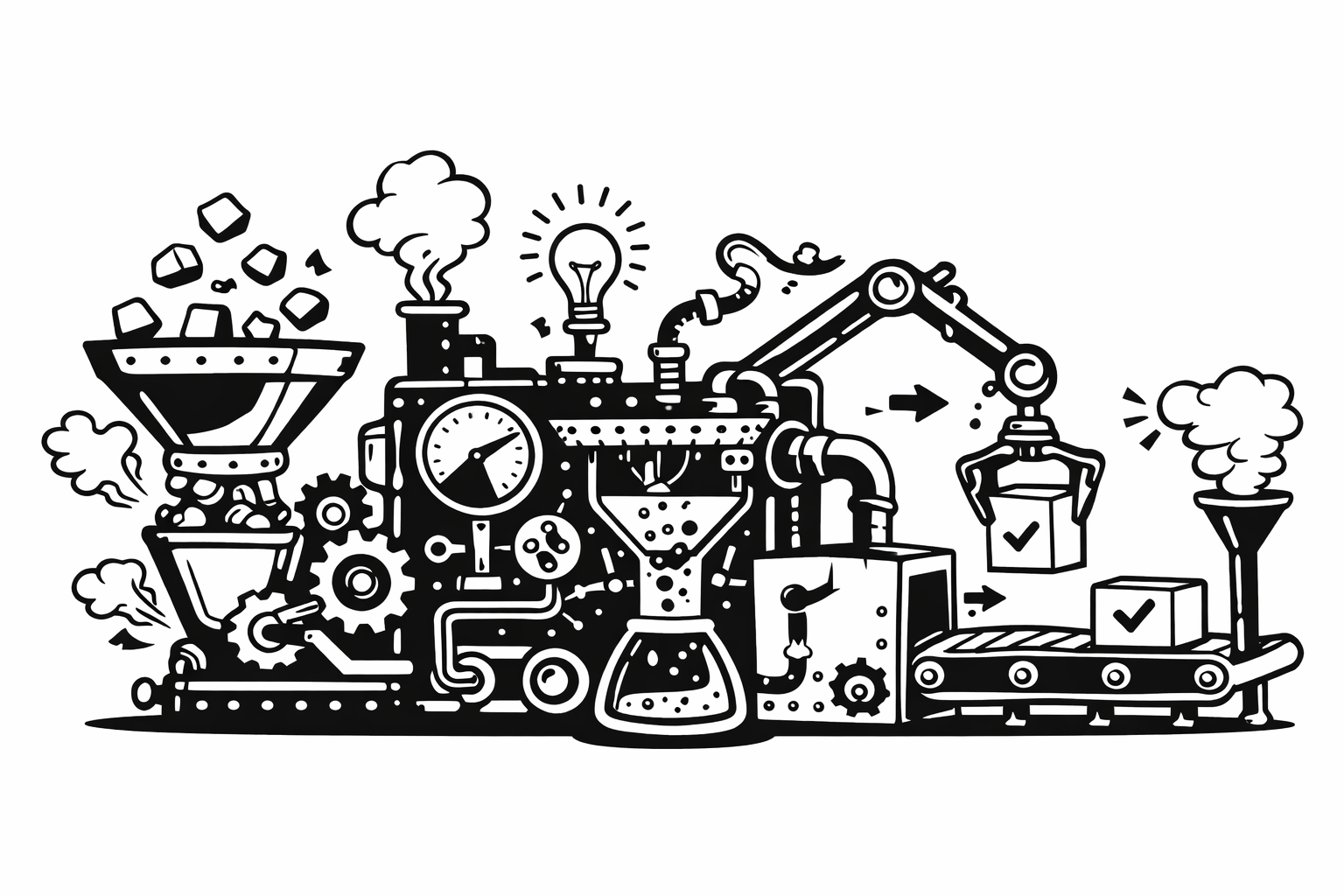
A sales process is a product
A sales process is not a document you publish once. It is a product you ship, iterate, and defend.
The strongest teams treat process the same way great product teams treat onboarding:
- It is designed around what the buyer is trying to do.
- It reduces cognitive load for the rep.
- It makes outcomes measurable.
- It creates consistency without killing good judgment.
If your process is vague, the team does not become “creative.” They become random. Each rep invents their own funnel, your forecasts become stories, and your best practices never compound.
If your process is rigid, you get the opposite failure mode. Reps start gaming stages, dragging deals forward to look busy, and the process becomes theater.
The goal is neither freedom nor control. The goal is a sales machine that can be trusted.
Process vs methodology (and why it matters)
Most teams mix up two different things:
- Sales process: the sequence of stages a deal moves through, with definitions, artifacts, and metrics.
- Sales methodology: the philosophy and tactics you use inside the stages (MEDDICC, SPICED, Challenger, Sandler, and so on).
This distinction matters because you can change your methodology without rebuilding your CRM. You can also run multiple methodologies inside one process.
A good process is stable. It gives you shared language and consistent data. A good methodology is adaptable. It gives you better conversations.
When you confuse the two, you either:
- Over-engineer your CRM to match a methodology, then never change it, even when your market changes.
- Or you keep your CRM generic, then act surprised when onboarding takes six months and forecasting never improves.
The design principles of a scalable process
Before the stages, decide what you believe about your buyers and your business. These principles keep you honest.
1. Stages should reflect buyer commitments, not seller activities. A demo is an activity. A buyer agreeing to bring procurement into the conversation is a commitment. Commitments are what move deals.
2. Every stage needs entry criteria and exit criteria. This is the simplest way to reduce “stage inflation.” If a deal cannot meet the exit criteria, it cannot advance. That discipline is what makes forecasting possible, and why clear stage exit criteria keep showing up in practical sales process guidance.
3. The process must be teachable to a new rep in week one. If it only makes sense once you have closed 20 deals, it is not a process. It is folklore.
4. The process must create better customer experience, not just better reporting. If your buyers feel pushed, rushed, or repeatedly re-educated, you have built a system for your dashboard, not for your customer.
5. The process must be instrumented. If it cannot be measured, it cannot be improved. And if it is not improved, it decays.
The seven stages (with practical definitions)
You can name your stages differently, and you should tailor them to your model (self-serve, SMB, enterprise, channel). But most scalable motions converge on the same seven.
Below is a version that works well for B2B SaaS and modern services.
1) Targeting and lead capture
This stage is about deciding who deserves attention.
Entry criteria
- A person or account exists in your addressable market.
Exit criteria
- You have a reason to believe there is a problem worth discussing.
- You have a clear first outreach angle (not just “checking in”).
Rep actions
- Select a segment you can win (not the whole market).
- Choose a trigger: hiring, product launch, regulatory change, tooling shift, new executive, expansion into a new region.
- Build a short account hypothesis: “I think you might care about X because of Y.”
Artifacts to capture
- Segment, trigger, and hypothesis in CRM notes.
If this stage is weak, everything downstream becomes noisy. Reps feel busy, pipeline looks healthy, and win rates quietly collapse.
2) Qualification
Qualification is not about disqualifying leads aggressively. It is about allocating time intelligently.
Entry criteria
- The prospect has engaged, replied, booked time, or shown clear intent.
Exit criteria
- You know whether there is a real problem, a plausible buyer, and a plausible path to a decision.
Rep actions
- Establish the “why now.” If there is no time pressure, there is rarely a deal.
- Confirm the category fit (use case, size, environment, constraints).
- Identify who will be involved in the decision.
Artifacts to capture
- A qualification score or simple labels (Strong fit, Possible fit, Not a fit).
A common mistake is trying to qualify with interrogation. Great qualification feels like clarity, not a checklist.
3) Discovery
Discovery is where deals are won or lost, long before pricing shows up.
Entry criteria
- You have enough fit to justify a real conversation.
Exit criteria
- A documented problem statement and desired outcome.
- A clear set of constraints (security, timeline, integrations, legal).
- Agreement on what “success” would look like.
Rep actions
- Map pain to measurable impact: revenue, cost, risk, or time.
- Separate symptoms from causes.
- Ask what they have already tried. The answer tells you what landmines exist.
Artifacts to capture
- Problem statement, success criteria, current stack, and blockers.
If you do discovery properly, your later stages become easier because you are not selling a product. You are helping them complete a decision.
4) Solution alignment (demo, workshop, evaluation)
This is where most teams over-index. They think the demo is the sale. The demo is just one form of alignment.
Entry criteria
- Success criteria are documented.
Exit criteria
- The prospect agrees the solution matches the success criteria.
- Next step is scheduled with a specific purpose (technical review, pilot, stakeholder alignment).
Rep actions
- Demonstrate only what matters to their success criteria.
- Involve the right internal partners early (SE, security, implementation).
- Provide materials that make internal selling easier, including buyer-enablement content like comparisons, implementation outlines, and purchasing guidance.
Artifacts to capture
- Evaluation plan, stakeholders, and committed next step.
Alignment is not “they liked the demo.” Alignment is “they can explain the value to someone who was not on the call.”
5) Business case and internal alignment
Enterprise deals often die here, quietly, because the rep mistakes enthusiasm for consensus.
Entry criteria
- Solution alignment exists.
Exit criteria
- A quantified business case is agreed.
- The buying group is aligned on the decision path.
Rep actions
- Build an ROI narrative that is credible and conservative.
- Identify the executive sponsor (or accept that you do not have one).
- Surface objections early, especially around switching costs and risk.
Artifacts to capture
- Business case summary, champion strength, and decision plan.
This stage is the bridge between “this is interesting” and “we are actually buying.” Treat it as such.
6) Proposal, negotiation, and close
Closing is not the moment where you apply pressure. It is the moment where you remove friction.
Entry criteria
- Decision path is clear.
- Procurement and legal requirements are known.
Exit criteria
- Signed agreement.
- Implementation start date confirmed.
Rep actions
- Provide a clean proposal that maps directly to success criteria.
- Keep scope crisp. “Nice to have” items balloon risk.
- Negotiate thoughtfully. Concessions should buy something: multi-year, reference, faster signature, expanded scope.
Artifacts to capture
- Final pricing, term length, start date, and negotiated concessions.
The best close feels calm because it is mostly administrative. That calm is earned in the earlier stages.
7) Handoff, onboarding, expansion
A process that ends at signature is not a sales process. It is a revenue recognition ritual.
Entry criteria
- Contract executed.
Exit criteria
- Customer is live or has completed the first milestone.
- Success plan exists.
Rep actions
- Run a structured handoff with clear context: problem, success criteria, stakeholders, risks.
- Set expectations. The first 30 days are where churn is quietly engineered.
- Identify expansion paths while context is fresh.
Artifacts to capture
- Success plan, adoption milestones, expansion hypotheses.
When onboarding is strong, referrals and expansions become more natural, and your pipeline quality improves without extra spend.
The hidden layer: definitions, fields, and rules
Most “sales process” projects fail because the team only designs stages. The real leverage is the layer beneath.
Here is what to define for each stage:
- Stage purpose: what this stage is trying to prove.
- Buyer commitments: what the customer has agreed to do.
- Required fields: what must be known to advance.
- Required artifacts: mutual action plan, business case, security checklist, evaluation plan.
- Time-in-stage guideline: what “healthy” looks like.
- Common failure modes: why deals stall here.
And here is what to define across the full process:
- Lead response SLA: how quickly inbound is touched.
- Handoff rules: SDR to AE, AE to CS, partner to direct.
- Disqualification reasons: not as a blame tool, but as a learning tool.
- Stage reversion rule: if new information invalidates earlier assumptions, the deal goes back.
A process with no rules becomes politics. A process with too many rules becomes bureaucracy. Aim for the smallest set of rules that keeps data trustworthy.
Metrics that actually improve performance
Vanity metrics keep teams busy. Operational metrics make teams better.
Track these as a baseline:
- Conversion rate between stages (not just win rate)
- Time in stage (median, not average)
- Loss reasons by stage
- No next step rate (deals with no scheduled event)
- Slipped close date rate
- Multi-threading rate (number of engaged stakeholders)
Then add a few “truth serum” metrics:
- Discovery quality: percent of deals with documented success criteria and quantified impact.
- Champion strength: a simple internal score, reviewed in forecast.
- Deal velocity by segment: your SMB motion should not be judged by enterprise timelines.
A sales process becomes a competitive advantage when it creates feedback loops. Metrics are the instrumentation that turns activity into learning.
Where automation and AI fit (without breaking trust)
Automation should not replace selling. It should replace forgetting.
Use automation for:
- Task reminders tied to stage changes.
- Auto-generated mutual action plan templates.
- Routing and SLAs for inbound and product-qualified leads.
- Call summarization and note capture (with rep review).
- Deal risk flags: no next step, single-threaded, missing business case, long time in stage.
Be careful with automation that touches the buyer. If every message feels generated, trust erodes. The sweet spot is internal leverage plus selective, high-quality external communication.
AI is especially useful when it helps reps think, not when it helps them spam. The highest ROI usually comes from:
- Pre-call research synthesis.
- Post-call recap drafts.
- Objection pattern analysis.
- Coaching prompts aligned to your stage definitions.
A simple rollout plan (30-60-90)
A sales process only works if it is adopted. Adoption is not a training event. It is change management.
Days 1-30: design and alignment
- Interview top reps and recent buyers.
- Draft stage definitions, entry and exit criteria, and required fields.
- Build the process in CRM with minimal required fields.
- Create a one-page “how we sell here” summary.
Days 31-60: pilot and iterate
- Pilot with a small group of reps.
- Run weekly deal reviews using the new definitions.
- Adjust what is unclear, remove what is unused.
- Create templates: discovery plan, evaluation plan, business case.
Days 61-90: rollout and governance
- Train the full team, then reinforce with coaching.
- Update dashboards and forecasting routines.
- Publish a playbook that maps stage to actions and assets.
- Set a monthly process review cadence with Sales, Marketing, and CS.
If you do not add governance, entropy wins. The process slowly drifts, and you end up with an expensive CRM and a tribal sales culture.
The standard you should hold yourself to
A mature sales process is one where:
- A new rep can run a good deal with confidence.
- A sales leader can forecast without theatrics.
- A customer feels guided, not managed.
- The company can improve win rate and cycle time through learning, not through pressure.
That is the quiet promise of a well-built process. Not control. Not compliance. Compounding.